
Confused between tiles and epoxy flooring? Compare durability, cost, maintenance, design, installation and benefits to choose the right flooring for your space.
Tiles vs Epoxy Flooring: Which Is Better for Your Home or Commercial Space?
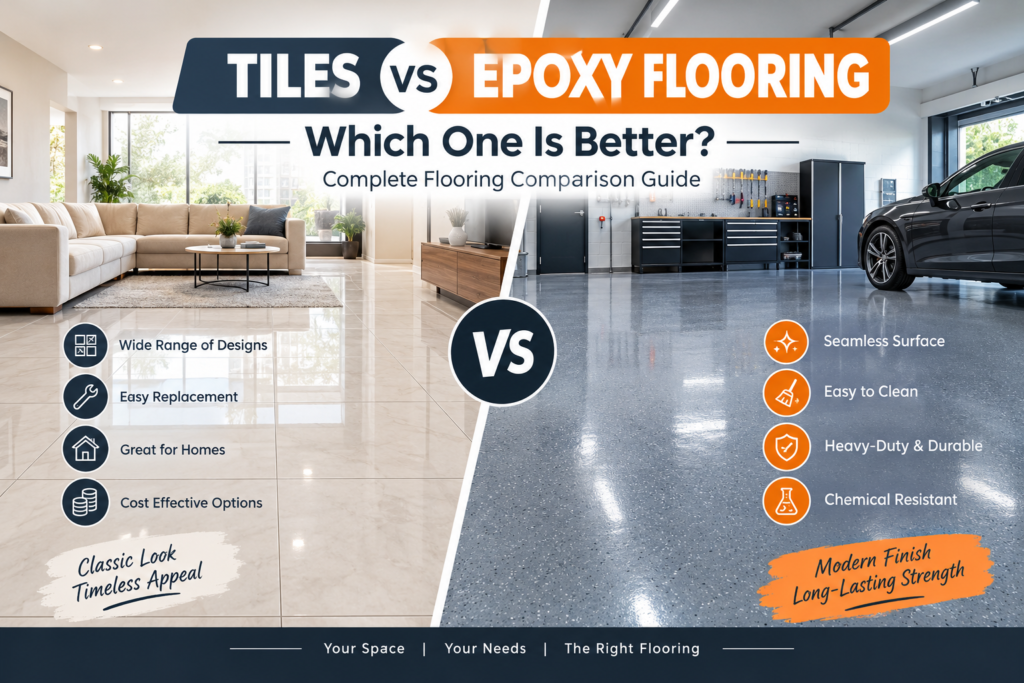
Choosing the right flooring can make a major difference in the appearance, durability, maintenance and overall performance of a space. Two popular options are tile flooring and epoxy flooring. But which one is better?
The answer depends on where the flooring will be installed, how much traffic the area receives, your maintenance requirements, design preferences and budget.
In this guide, we will compare tiles vs epoxy flooring in detail so you can understand the advantages, disadvantages, cost considerations and ideal applications of both flooring options.
What Is Tile Flooring?
Tile flooring is one of the most commonly used flooring solutions for homes, offices, shops and commercial properties. Tiles are available in different materials, including ceramic, porcelain, vitrified and natural stone.
They are available in a wide range of:
- Colours
- Patterns
- Sizes
- Textures
- Finishes
- Designs
Tile flooring can be used in living rooms, bedrooms, kitchens, bathrooms, offices, showrooms and many other areas.
One of the biggest advantages of tiles is the large variety of designs, making it easy to match the flooring with your interior style.
What Is Epoxy Flooring?
Epoxy flooring is a resin-based flooring system that is applied over a properly prepared concrete or suitable existing surface. Once cured, it creates a hard, smooth and seamless floor surface.
Epoxy flooring is commonly used in:
- Garages
- Warehouses
- Factories
- Workshops
- Commercial spaces
- Showrooms
- Hospitals
- Offices
- Industrial facilities
- Parking areas
Depending on the system and application, epoxy flooring can provide a smooth, durable and easy-to-clean surface.
Tiles vs Epoxy Flooring: Complete Comparison
| Feature | Tile Flooring | Epoxy Flooring |
|---|---|---|
| Appearance | Wide range of designs | Modern, seamless appearance |
| Durability | Good to excellent depending on tile | High when correctly installed |
| Maintenance | Easy | Very easy |
| Grout Lines | Yes | No |
| Cleaning | Easy | Very easy |
| Water Resistance | Good, depends on tile/grout | Excellent when properly installed |
| Chemical Resistance | Varies | Generally excellent in suitable systems |
| Installation | Tile-by-tile installation | Coating/system application |
| Repair | Individual tiles can be replaced | Damaged area may require repair/recoating |
| Customisation | Very high | Colours, flakes, patterns and finishes available |
| Heavy Traffic | Suitable with correct tile selection | Excellent for many commercial applications |
| Industrial Use | Limited depending on tile | Highly suitable |
| Home Use | Excellent | Suitable for selected applications |
| Seamless Surface | No | Yes |
| Grout Maintenance | Required | Not required |
Durability: Tiles vs Epoxy Flooring
Durability is one of the most important factors when selecting flooring.
High-quality porcelain or vitrified tiles can provide excellent durability when correctly selected and installed. However, tiles can crack or chip if subjected to strong impact or if the underlying surface has problems.
Epoxy flooring creates a continuous surface and can provide excellent resistance to abrasion and heavy traffic when the correct epoxy system is selected and the substrate is properly prepared.
Winner: Epoxy Flooring
For areas with heavy traffic, workshops, garages and many industrial or commercial environments, epoxy can be an excellent choice.
Maintenance and Cleaning
Tiles are relatively easy to clean. However, the grout lines between tiles can collect dirt and stains over time.
Epoxy flooring provides a seamless surface without traditional grout joints, which makes routine cleaning easier. Dust, dirt and spills can generally be removed with normal cleaning methods appropriate for the flooring system.
Winner: Epoxy Flooring
If easy maintenance and a seamless surface are priorities, epoxy flooring has an advantage.